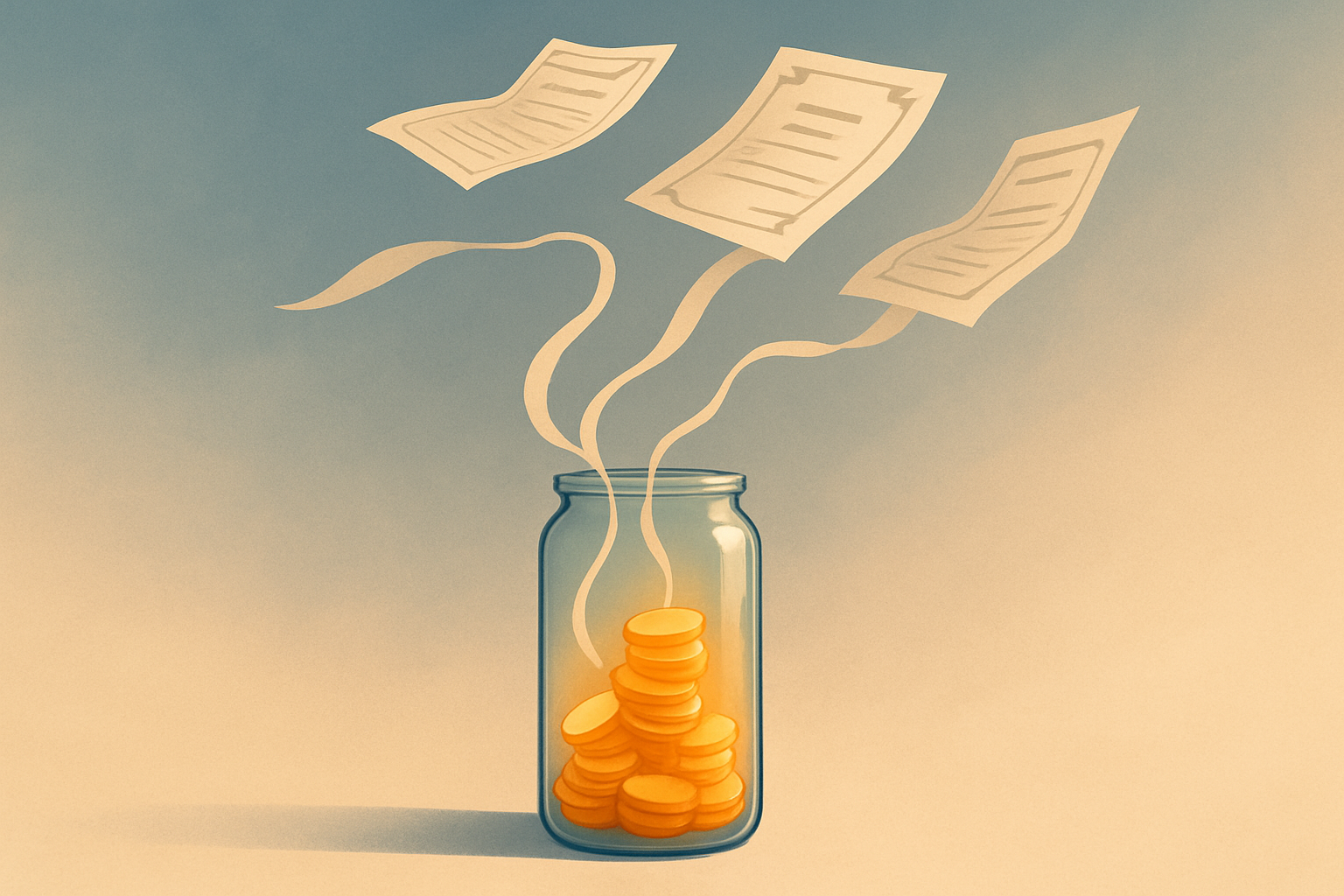
The Connection Most Savers Never Think About
You open your online savings account dashboard, see the interest rate, and maybe wonder: Where does that number actually come from? It feels almost arbitrary — one bank offers 4.2%, another offers 3.9%, and your old brick-and-mortar bank is still stuck somewhere under 1%. The answer lies in a chain of market forces that starts with U.S. Treasury bill rates and ends in your deposit account.
Understanding that chain can help you spot when rates are about to move, choose the right account at the right time, and keep more of your money working harder.
What Drives Interest Rates in the First Place?
Before tracing the path from Treasury bills to your savings account, it helps to know the two key benchmarks that matter most.
The Federal Funds Rate: The Starting Point
The federal funds effective rate — the rate at which depository institutions lend reserve balances to each other overnight — is one of the most-watched numbers in finance. As of the most recent reading, it sits at 3.64% (source). This rate is set by Federal Reserve policy and acts as a floor beneath which short-term borrowing costs rarely fall.
When this rate is high, banks can earn more by parking money in safe, short-term instruments. When it’s low, those same instruments pay almost nothing.
Treasury Bill Yields: The Market’s Real-Time Signal
Treasury bills are short-term U.S. government securities. The weighted-average yield on outstanding U.S. Treasury bills currently stands at 3.696% (source). That figure moves continuously with market demand and Federal Reserve policy expectations — it’s effectively the market’s best guess about where short-term rates are headed.
Meanwhile, the 10-year Treasury constant maturity rate is 4.45% (source), which tells you what investors demand to lock money away for a decade. The gap between that long-term rate and the short-term T-bill yield tells a story about where the economy and interest rates may be heading.
How Treasury Bill Rates Flow Into Your Savings Account
Here’s the key mechanism, explained simply.
Online banks and other deposit-taking institutions compete for your cash. They need deposits to fund loans and other activities. But they also have an alternative: they can invest in Treasury bills and other short-term government securities. When T-bill yields are high — say, near 3.7% — a bank that wants to attract your deposit has to offer you something competitive with that, or you might simply buy T-bills yourself (or choose a competitor who pays more).
That competitive pressure is what pushes online savings account rates up when Treasury bill yields rise. The reverse is also true: when T-bill yields fall, banks have less reason to pay you generously, and rates drift lower.
Why Online Banks Respond Faster
Online banks tend to respond to Treasury yield movements more quickly than traditional branch-based institutions. According to the FDIC’s May 2026 national rate data, the national average savings deposit rate is 0.38% — a figure that reflects the drag of thousands of traditional banks still paying near-zero (source). Online banks, which rely almost entirely on rate-sensitive depositors who shop around, have a strong incentive to stay closer to the T-bill yield benchmark.
This is also why a meaningful gap exists between what the “average” bank pays and what the best online accounts offer. The FDIC’s national rate cap for savings accounts — calculated as the higher of the national rate plus 75 basis points or the federal funds rate plus 75 basis points — currently stands at 4.39% (source). That cap limits how aggressively a less-than-well-capitalized institution can solicit deposits by offering rates that significantly exceed prevailing market rates, as defined by the FDIC’s revised rule (source).
The 10-Year Treasury: A Window Into Future Rate Moves
Most online savings accounts carry variable rates — meaning the bank can change them at any time. So even if you lock in a great rate today, it may not last.
The 10-year Treasury rate at 4.45% (source) is worth watching because it reflects long-term investor expectations. When long-term rates are meaningfully higher than short-term T-bill yields (currently around 3.696% (source)), the market is generally signaling that rates may stay elevated or move higher. That’s good news for savers who want competitive deposit rates to stick around.
If the gap between long-term and short-term rates were to narrow or flip — with short-term yields exceeding long-term ones — that would typically suggest the market expects rate cuts ahead, which would eventually filter through to lower savings account rates.
What This Means for Your Online Savings Account Today
With the federal funds rate at 3.64% (source) and T-bill yields near 3.696% (source), competitive online savings accounts are operating in a genuinely favorable environment for savers — at least compared to the near-zero rates of a few years ago.
According to CBS News’s 2026 savings rate analysis, a rate of 4% or higher is considered a good high-yield savings account rate in the current climate, and online banks are the most likely place to find it (source). The same source notes that traditional savings accounts are averaging under 0.40%, making the gap between online and traditional accounts substantial (source).
The FDIC Safety Net Still Applies
One thing that doesn’t change regardless of the rate environment: deposit insurance. The FDIC insures deposits up to $250,000 per depositor, per bank, per ownership category (source). That coverage applies equally to high-yield online savings accounts at FDIC-member institutions, so you don’t have to sacrifice safety to chase a better rate.
How Series I Savings Bonds Fit Into the Picture
If you’re weighing alternatives to an online savings account, Series I Savings Bonds are worth understanding here. The average yield on outstanding U.S. Series I Savings Bonds is currently 4.349% (source) — slightly above the T-bill weighted average and competitive with top online savings rates.
I Bonds are U.S. government securities whose interest rate adjusts with inflation, making them a different kind of instrument than a savings account. They’re not a direct substitute for an online savings account because of their redemption restrictions, but they’re worth knowing about as part of the broader landscape of government-backed savings options.
The National Savings Rate: A Surprising Contrast
Here’s a striking irony. Even with deposit rates at levels that are genuinely attractive by recent historical standards, Americans aren’t saving more. The U.S. personal savings rate — the share of disposable income that households set aside — is just 2.6% (source) as of the most recent data.
As the Forbes analysis on savings rate drivers notes, the national personal savings rate hovered around 4% to 5% in 2025, which is still below the longer-run historical average — and the current 2.6% reading represents a further decline (source). Higher deposit rates, it turns out, don’t automatically motivate people to save more. Spending pressures, consumer confidence, and lifestyle inflation all play a role.
That means the opportunity to earn meaningful interest on savings is real — but only for those who actually set money aside to take advantage of it.
Practical Steps: Getting the Most From the Rate Environment
Step 1: Compare Online Savings Accounts Against the T-Bill Benchmark
The T-bill weighted-average yield of 3.696% (source) is a useful yardstick. If an online savings account is paying meaningfully less than that, it may not be passing along the full benefit of the current rate environment. Shop around.
Step 2: Watch the Federal Funds Rate for Signals
Because online savings account rates are variable, they’ll move when the federal funds rate moves. The current rate of 3.64% (source) has been holding relatively steady, but any shift in Federal Reserve policy will ripple through to your savings account rate within weeks — sometimes days.
Step 3: Understand the FDIC Rate Cap Context
The FDIC’s national rate cap of 4.39% for savings accounts (source) sets an upper boundary for how much a less-than-well-capitalized institution can offer. This is a regulatory guardrail, not a ceiling for the industry as a whole — but it gives you a sense of the range within which legitimate, competitive rates operate.
Step 4: Don’t Ignore the 10-Year Treasury Signal
Keep an eye on the 10-year Treasury rate (currently 4.45% (source)). If long-term rates start falling sharply, that’s often an early signal that short-term rates — and your savings account yield — may follow. It gives you a heads-up to consider locking in rates with a certificate of deposit before they drop.
Step 5: Stay FDIC-Insured
Always confirm that any online bank you use is an FDIC member. The $250,000 insurance limit per depositor, per bank, per ownership category (source) means your principal is protected even if the bank fails. Chasing yield at an uninsured institution is a risk that’s rarely worth taking.
Putting It All Together
The rate your online savings account pays isn’t random. It’s anchored to a chain of market forces: the Federal Reserve’s federal funds rate (3.64% (source)), the Treasury bill market (weighted-average yield of 3.696% (source)), and the competitive pressure among banks to attract rate-sensitive depositors.
Online banks sit closer to that market signal than traditional institutions, which is why the FDIC’s national average savings rate of 0.38% (source) looks so different from what the best online accounts offer. The 10-year Treasury at 4.45% (source) suggests the rate environment remains relatively favorable for savers — for now.
The personal savings rate of just 2.6% (source) is a reminder that knowing about a good rate environment and actually taking advantage of it are two different things. The mechanics are in your favor. The next step is yours.
This article was researched using official U.S. data sources cited inline and reviewed for accuracy before publishing. It is general information, not personalized financial advice. For decisions specific to your situation, consult a licensed professional.
Data refreshed: 2026-06-01. Editorial accuracy verified for cited sources only.
Related reads
- Why Americans Are Saving Less Even When Deposit Rates Are High: The 2026 Savings Rate Explained
- Fidelity vs Schwab vs Vanguard for a Roth IRA in 2026: Zero-Commission ETF Trading and Account Minimums Compared
- FDIC Insurance Limits Explained: How to Protect More Than $250,000 Across Bank Accounts

Armin Cole has been personally investing in index funds and ETFs
for over three years. He started Nestvestify to document what he’s
learning and make data-backed personal finance accessible to everyday
readers — without the jargon. All articles are grounded in official
U.S. data sources including the Federal Reserve (FRED), SEC filings,
and the Bureau of Labor Statistics.