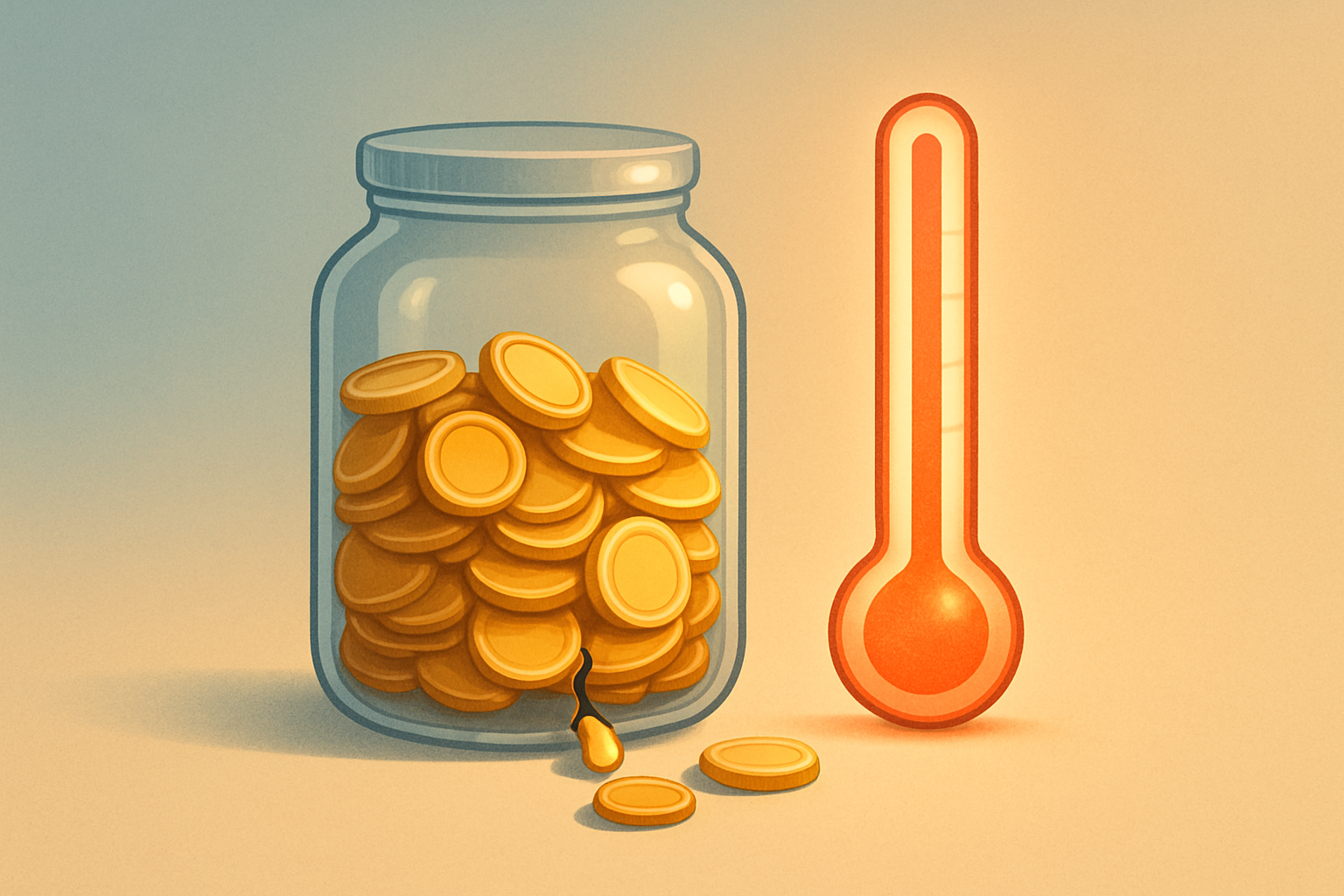
The Savings Paradox Nobody Talks About
Here is something that feels counterintuitive: deposit rates are sitting near multi-year highs, yet Americans are saving less than they have in decades. The federal funds effective rate stands at 3.64% (source), and short-term government yields are similarly elevated — the 3-month Treasury bill is yielding 3.69% (source). Even average Series I Savings Bonds are paying 4.349% (source). On paper, the incentive to save has rarely looked better.
Yet the US personal savings rate has dropped to just 2.6% (source) as of April 2026. That is the share of after-tax, after-expense income that American households are actually setting aside — whether in a checking account, savings account, IRA, or employer-sponsored 401(k) (source). By almost any historical measure, that number is startlingly low.
So what is going on? Why are high rates failing to pull more money into savings accounts? The answer is a mix of rising costs, shifting behavior, and a few economic forces that rarely get explained in plain English.
What the Personal Savings Rate Actually Measures
Before getting into the why, it helps to be clear on the what. The Bureau of Economic Analysis (BEA) defines the personal savings rate as the portion of income Americans have left after paying taxes and expenses — and it is tracked monthly (source).
One important nuance: the savings rate does NOT count capital gains. If your stock portfolio went up in value, or your home appreciated, none of that shows up here. It is purely a cash-flow measure — income minus spending and taxes, expressed as a percentage of income (source).
That distinction matters more than it might seem. A household that owns a home or holds a brokerage account might feel wealthy even while spending more than it technically saves in cash terms. This is one reason the savings rate can look alarming while many Americans still feel financially okay — at least for now.
A Brief History: Where the Savings Rate Has Been
To understand how low 2.6% really is, a little history helps.
During the 1960s and 1970s, Americans routinely saved a much larger share of their income — the average across those decades was 11.7%, with a peak of 17.3% reached in May 1975 (source). That era of high saving was shaped by different norms around credit, fewer consumer goods to spend on, and stronger social safety nets in some communities.
The rate gradually declined over the following decades, hitting an all-time low of 1.4% in July 2005 — right in the middle of the housing bubble, when home equity felt like a personal ATM and credit was easy to come by (source).
Then came the COVID-19 pandemic, which produced one of the strangest savings anomalies in modern history. The rate spiked to 32.0% in April 2020 (source) — stimulus checks were arriving, and there was almost nowhere to spend money. That surge was dramatic but short-lived. As the economy reopened, Americans spent down those savings quickly, and the rate has been trending lower ever since.
Today’s reading of 2.6% (source) is well below the long-run average and approaching territory not often seen outside of bubble periods or post-pandemic spending surges.
Why High Rates Aren’t Saving the Savings Rate
This is the core puzzle. When banks and brokerages are offering competitive yields, why aren’t more people saving?
1. Rising Costs Are Eating Into Every Paycheck
The most direct explanation is that higher prices on everyday essentials are leaving less room to save, even for households that haven’t changed their habits. When groceries, utilities, housing, and healthcare all cost more, saving gets harder — not because people don’t want to save, but because the dollars left after necessary spending have shrunk (source).
This is especially true for renters and lower-income households. In 2023, nearly 33% of households were “cost-burdened,” meaning they spent more than 30% of their income on mortgage or rent (source). When housing alone consumes that much of a budget, there is simply less left over.
Inflation drives up food and energy costs, and wages do not always keep pace (source). A household might bring home the same paycheck but find that groceries and utility bills now cost meaningfully more — effectively a pay cut in real terms.
2. The “Wealth Effect” Makes People Feel Richer Than They Are
Remember that the savings rate excludes capital gains. From 2019 to 2022, the share of American assets held in stocks rose from 15.2% to 20.0% (source). When stock portfolios and home values are climbing, people naturally feel more financially secure — and they spend accordingly.
This behavioral pattern, often called the “wealth effect,” means that even households with modest incomes may pull back on cash saving when their paper wealth is growing. The problem is that paper gains can evaporate quickly, while spending habits tend to be sticky.
3. High Rates Help — But Only If You Have Cash to Save
Here is the catch with today’s rate environment: it only benefits people who have money to deposit. If your budget is already stretched thin, a 3.69% Treasury yield (source) or a 4.349% I-Bond rate (source) is largely beside the point. You cannot save money you do not have.
For households living paycheck to paycheck, attractive deposit rates are a headline benefit they cannot actually access. The people most likely to take advantage of high yields are those who already have a financial cushion — which means the current rate environment may be widening the gap between savers and non-savers rather than lifting everyone.
4. Credit Has Made Spending Easier
The flip side of not saving is spending — and credit cards, buy-now-pay-later services, and personal loans have made it easier than ever to spend money you have not yet earned. When credit is accessible, the immediate cost of spending feels lower, even if the long-term cost in interest charges is quite high.
This dynamic is not new, but it has intensified. According to CNBC reporting (source), more Americans are relying on credit to cover basic monthly expenses — a sign that for many households, the gap between income and spending is being bridged by borrowing rather than savings.
5. Retirement Accounts Are Being Tapped Early
Another warning sign: more workers are borrowing from or making hardship withdrawals from their 401(k) accounts to cover current expenses (source). While 401(k) contributions do count toward the savings rate, withdrawals and loans effectively reverse some of that saving — and they carry real long-term costs in lost compounding and potential tax consequences.
The FDIC Safety Net: Still Solid, But Not a Substitute for Saving
One thing that has not changed: the federal deposit insurance backstop. The FDIC insures up to $250,000 per depositor, per bank, per ownership category (source). Money sitting in a federally insured checking or savings account is protected up to that limit — a meaningful assurance for anyone who does manage to build a cash cushion.
But FDIC insurance protects what you have already saved. It does not help you save more. The safety net is only useful if there is something to catch.
What a Low Savings Rate Means for the Economy
Personal saving is not just a household concern — it has real implications for the broader economy. Consumer spending on goods and services is the engine of US economic activity, so when people spend more and save less, it can actually support short-term growth (source). Businesses see stronger revenues, hiring stays solid, and the economic machine keeps turning.
But there is a fragility baked into this picture. Households with minimal savings have almost no buffer if income slows or an unexpected shock hits — whether from a job loss, a medical emergency, or a broader economic downturn (source). The lower the savings rate, the less resilience consumers have.
Over the longer term, higher saving rates support capital accumulation, which funds retirement, big purchases like cars and homes, and investments in education (source). A sustained stretch of very low saving can quietly erode the financial foundations that households depend on years down the road.
What You Can Actually Do About It
If the national savings rate reflects structural pressures, what can an individual household do? A few practical ideas:
Make High Rates Work For You — Even With Small Amounts
You do not need a large lump sum to benefit from today’s rate environment. Even modest, consistent deposits into a high-yield savings account or a short-term Treasury product can earn meaningfully more than a traditional passbook account. The 3-month T-bill is yielding 3.69% (source), and average I-Bond yields are at 4.349% (source). Starting small still beats starting never.
Automate Before You Can Spend It
The single most effective saving habit is automation. When a portion of your paycheck moves to savings before you see it, you naturally adjust your spending to what remains. This sidesteps the willpower problem entirely.
Separate “Saving” From “Not Spending”
A lot of people think they are saving because they skipped an extravagant purchase. But saving means money actually moving into a designated account — not just avoiding a splurge. The BEA’s definition is strict: it is the cash you set aside after expenses and taxes (source). Make sure your “saved” money is actually somewhere it can grow.
Protect What You Have
If you do have savings, make sure they are sitting in an FDIC-insured account (up to $250,000 per depositor, per bank, per ownership category — source) and earning a competitive rate. Leaving money in a low-yield account while high-yield options exist is a quiet cost that compounds over time.
The Bottom Line
The US personal savings rate of 2.6% (source) tells a complicated story. It is not simply that Americans are reckless or indifferent to saving. For many households, rising costs on essentials are genuinely squeezing the margin available for saving, even as headline deposit rates look attractive. For others, rising asset prices create a false sense of security. And for the segment already living paycheck to paycheck, high deposit rates are a benefit they simply cannot reach.
The federal funds rate at 3.64% (source) and T-bill yields near 3.69% (source) represent a genuine opportunity — but only for households with the margin to take advantage. Building that margin, even slowly, is the real challenge.
Understanding why the savings rate is low is the first step. Deciding that your own savings rate does not have to follow the national trend is the second.
This article was researched using official U.S. data sources cited inline and reviewed for accuracy before publishing. It is general information, not personalized financial advice. For decisions specific to your situation, consult a licensed professional.
Data refreshed: 2026-05-31. Editorial accuracy verified for cited sources only.
Related reads
- 3-Month T-Bill vs. 6-Month CD: How to Build a Short-Term Savings Ladder in 2026
- Americans Are Saving Just 2.6% of Their Income — Here’s What That Means for Your Emergency Fund
- Is Your Savings Account Actually Beating Inflation in 2026?

Armin Cole has been personally investing in index funds and ETFs
for over three years. He started Nestvestify to document what he’s
learning and make data-backed personal finance accessible to everyday
readers — without the jargon. All articles are grounded in official
U.S. data sources including the Federal Reserve (FRED), SEC filings,
and the Bureau of Labor Statistics.