
The One Number That Matters Most: Expense Ratio
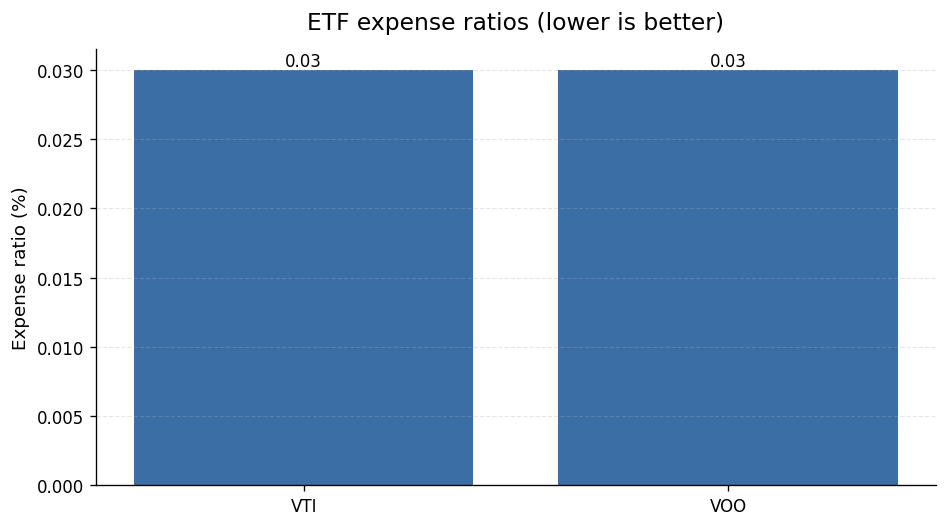
When you’re choosing between two low-cost index ETFs, the expense ratio is usually the first number you check — and for good reason. Even a tiny difference in annual fees compounds over decades. So here’s the short answer: as of 2026-05-18, both VTI and VOO carry an expense ratio of 0.03% (VTI source) (VOO source).
That works out to $3 a year on every $10,000 invested. It’s about as cheap as index investing gets.
A Quick Note on the SEC Data Discrepancy
You may have run across a slightly different figure in your own research. The SEC DERA Risk/Return Summary dataset — a publicly available set of ETF and mutual fund fee disclosures — shows VTI’s expense ratio as 0.06% (source) for an earlier reporting period (2026 Q1). Vanguard’s own product page, however, lists the current figure as 0.03% (source).
When two official sources disagree, it helps to know which one to use. The fund’s investor page reflects the most recently filed expense ratio, while SEC summary datasets are compiled from prospectus filings and can lag by a reporting period. For comparison shopping, go with the 0.03% figure from Vanguard’s product page.
What Are These Two Funds, Exactly?
Both VTI and VOO are Vanguard exchange-traded funds (ETFs). At 0.03% each (VTI, VOO), they rank among the lowest-cost investment products available to US retail investors.
Beyond the fee, the key difference is the index each fund tracks. Since this article focuses on cost — and the reference sources available don’t cover index methodologies or holdings breakdowns — we’ll stick to what the official data actually shows.
Here’s what it shows:
- VTI had a closing price of $365.09 on 2026-05-21 (source).
- VOO had a closing price of $682.84 on 2026-05-21 (source).
- The S&P 500 Index closed at 7,445.72 on 2026-05-21 (source).
The share price gap between VTI and VOO doesn’t mean one fund is more expensive than the other in any meaningful sense — it’s simply how each fund happens to be priced per share. The cost that actually eats into your returns is the expense ratio, and both funds sit at 0.03%.
Breaking Down the 0.03% Expense Ratio
To make this concrete: an expense ratio of 0.03% (source) means the fund deducts 3 cents per year for every $100 of assets you hold. Here’s how that looks across different investment sizes:
| Investment Amount | Annual Fee at 0.03% |
|---|---|
| $1,000 | $0.30 |
| $10,000 | $3.00 |
| $50,000 | $15.00 |
| $100,000 | $30.00 |
These fees come out of the fund’s assets automatically — you won’t see a separate charge or write a check. The returns Vanguard publishes already account for the expense ratio being deducted.
Does the Expense Ratio Tie Mean You Should Just Pick Either One?
On cost alone, yes — there’s no fee advantage to choosing one over the other right now. Both VTI and VOO are at 0.03% (VTI, VOO), so your decision comes down to other factors.
A few worth thinking about:
Share Price and Accessibility
VTI’s closing price of $365.09 (source) is lower than VOO’s $682.84 (source). If your broker doesn’t support fractional shares and you’re investing a fixed dollar amount, VTI’s lower share price makes it easier to put your cash to work without leaving much sitting idle. That said, many brokers today do offer fractional investing — worth checking with your specific platform.
Broad Market vs. the S&P 500
The S&P 500 Index — which closed at 7,445.72 on 2026-05-21 (source) — is the standard benchmark for US large-cap stocks. VOO tracks this index. VTI tracks a broader slice of the US market. Rather than speculate on historical performance differences or holdings overlap beyond what the data supports, the straightforward point is this: the two funds track different indexes, and that affects your portfolio exposure even when the cost is identical.
Tax Treatment
Both funds are structured as ETFs, which generally carry certain tax advantages over traditional mutual funds. The specifics, though, depend on your account type — taxable brokerage versus tax-advantaged retirement account — and your personal tax situation. A licensed financial professional can help you work through that piece.
The Bottom Line on Fees
If you came here to find out whether VTI or VOO is cheaper, the honest answer is: neither. They’re tied at 0.03% (VTI, VOO). That’s genuinely good news — it means you can choose based on which index you want exposure to, not which fund charges less.
One footnote worth keeping: the SEC DERA dataset flagged VTI’s expense ratio at 0.06% (source) in its most recent summary, which is a useful reminder that official datasets can sometimes reflect earlier filings. Always cross-check with the fund’s own investor page for the current number.
Quick Reference: VTI vs. VOO at a Glance
| VTI | VOO | |
|---|---|---|
| Expense Ratio | 0.03% | 0.03% |
| Closing Price (2026-05-21) | $365.09 | $682.84 |
| Fee on $10,000 invested | $3/year | $3/year |
Sources: VTI expense ratio, VOO expense ratio, VTI price, VOO price
This article was researched using official U.S. data sources cited inline and reviewed for accuracy before publishing. It is general information, not personalized financial advice. For decisions specific to your situation, consult a licensed professional.
Data refreshed: 2026-05-22. Editorial accuracy verified for cited sources only.

Armin Cole has been personally investing in index funds and ETFs
for over three years. He started Nestvestify to document what he’s
learning and make data-backed personal finance accessible to everyday
readers — without the jargon. All articles are grounded in official
U.S. data sources including the Federal Reserve (FRED), SEC filings,
and the Bureau of Labor Statistics.