
The Fee War That Changed Index Investing
A few years back, Fidelity dropped a bombshell on the investing world: two index funds with a 0% expense ratio. Zero. Nothing. Not a fraction of a penny per dollar invested. It sounded almost too good to be true — and for a lot of everyday investors, it raised a very reasonable question: if Fidelity charges nothing and Vanguard charges something, shouldn’t I just go with Fidelity?
The honest answer is: it depends. The expense ratio is one piece of the puzzle, but it’s not the whole picture. Here’s what you actually need to know before choosing between Fidelity’s ZERO funds and Vanguard’s VTI.
What Are These Funds, Exactly?
Fidelity ZERO Total Market Index Fund (FZROX) is a mutual fund that owns a broad basket of U.S. stocks (source). It has no minimum investment and charges a 0% expense ratio. Fidelity launched it as part of a push to win over new investors who were increasingly sensitive to fees.
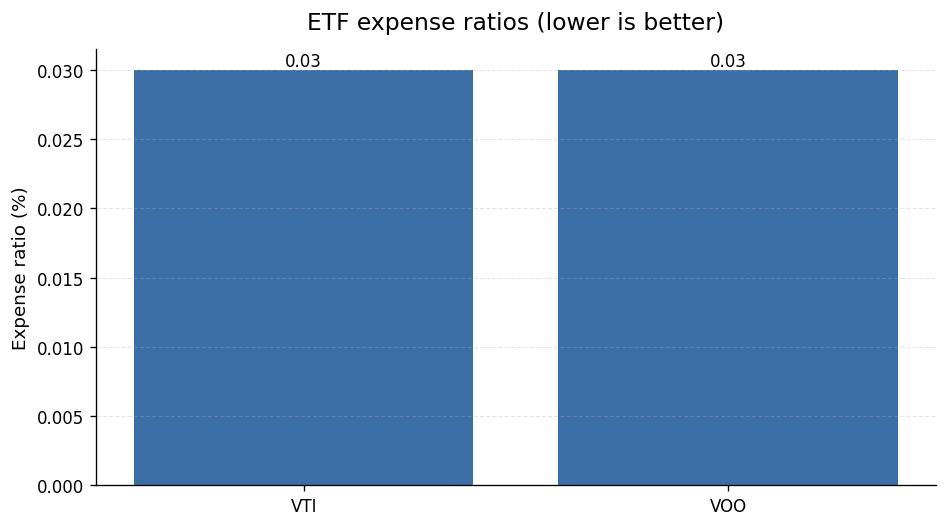
Vanguard Total Stock Market ETF (VTI) is an exchange-traded fund that also covers the broad U.S. stock market. Its expense ratio is 0.03% (source), which works out to just 30 cents per year on a $1,000 investment. Its most recent closing price was $363.38 (source).
Both funds give you exposure to the total U.S. stock market in a single, low-cost package. But the similarities start to diverge once you look a little closer.
The Expense Ratio: FZROX Wins on Paper
On the raw expense ratio number, FZROX wins. Zero beats 0.03% every time — at least on paper.
VTI charges 0.03% per year (source). On a $10,000 investment, that’s $3 a year. On $100,000, it’s $30 a year. These are genuinely tiny numbers, and for most investors the real-world difference between 0.03% and 0.00% is almost imperceptible over a typical investing horizon.
Still, a lower cost is a lower cost. If everything else were equal, you’d pick the cheaper option. The key question is whether everything else is equal — and that’s where things get interesting.
Trading Costs: A Level Playing Field
One thing that used to complicate fund comparisons was trading commissions. Buying an ETF like VTI used to cost a few dollars per trade at most brokerages. That changed when major U.S. brokerages — including Fidelity, Schwab, Vanguard, E*TRADE, and Robinhood — moved to $0 commissions on stock and ETF trades (source).
That means buying VTI today costs you nothing at the transaction level, just like buying FZROX. Commissions are no longer a reason to prefer a mutual fund over an ETF.
Market Coverage: Broad vs. Broader
Both FZROX and VTI aim to cover the U.S. stock market broadly. According to a detailed comparison published in Financial Planning, Fidelity’s ZERO fund owns “a very broad basket of U.S. stocks,” while Vanguard’s offering is described as even broader in terms of total holdings (source).
The practical takeaway: both funds give you exposure to hundreds or thousands of U.S. companies across large, mid, and small caps. The difference in coverage is unlikely to meaningfully affect your long-run returns, but if you want to own the widest possible slice of the market, the evidence suggests VTI edges ahead.
The ‘Loss Leader’ Question: Why Does Fidelity Offer 0%?
Here’s a question worth sitting with: how does Fidelity make money on a fund that charges nothing?
The answer, as noted in Financial Planning, is that Fidelity and similar competitors use these funds as “loss leaders” (source). The idea is straightforward: attract investors with a zero-cost product, and those investors will also keep cash at Fidelity, use Fidelity’s other services, and potentially invest in other Fidelity funds that do carry fees. Vanguard, by contrast, is described in the same analysis as a firm where “almost everything at Vanguard is already ultra-low cost” — it gains market share through its low-cost model rather than cross-subsidizing a flagship loss leader.
That doesn’t make FZROX a bad fund. It just means you should understand the business context. Fidelity is a for-profit company using FZROX as a customer acquisition tool, and that’s a perfectly legitimate strategy — but it’s worth knowing.
Tax Efficiency: Where VTI Has a Real Edge
This is arguably the most important factor that the headline “0% expense ratio” obscures — and it matters a lot if you’re investing in a taxable brokerage account.
The Financial Planning analysis found that when comparing these funds on tax efficiency, Vanguard still comes out on top (source). Here’s why that matters in plain English:
- ETFs like VTI are structured in a way that generally allows the fund manager to avoid distributing capital gains to shareholders. You typically don’t owe taxes on gains inside the fund until you decide to sell.
- Mutual funds like FZROX can be required to distribute capital gains to all shareholders at year-end, even if you personally didn’t sell anything. If that happens, you could owe taxes on gains you didn’t intentionally realize.
In a tax-advantaged account like a 401(k) or IRA, this distinction doesn’t matter — you’re not paying taxes on distributions anyway. But in a regular taxable account, the tax drag from a mutual fund’s capital gains distributions can easily outweigh a 0.03% annual fee over time.
The Financial Planning analysis put it plainly: “A big difference in fees may not be enough to offset taxes on capital gains” (source).
Portability: The Hidden Catch with FZROX
Here’s a practical consideration that doesn’t show up in any fee table but could matter a great deal someday.
VTI is an ETF that trades on a public exchange. You can hold it at Fidelity, Vanguard, Schwab, or virtually any other brokerage. If you ever want to move your account, your VTI shares go with you.
FZROX, as described in the Financial Planning analysis, is a Fidelity-specific fund (source). It’s not available at other brokerages. If you ever decide to switch, you’d need to sell your FZROX shares first — and in a taxable account, that sale could trigger a capital gains tax bill.
This lock-in effect is subtle but real. If you’re young, building a large position over decades, and accumulating significant unrealized gains, being forced to sell before transferring could cost you meaningfully in taxes. VTI doesn’t have this problem.
A Side-by-Side Look
Here is a simple comparison of the two funds based on available data:
| Feature | FZROX (Fidelity ZERO) | VTI (Vanguard) |
|---|---|---|
| Expense ratio | 0.00% | 0.03% (source) |
| Fund type | Mutual fund | ETF |
| Available at other brokerages | No (source) | Yes |
| Tax efficiency (taxable accounts) | Lower | Higher (source) |
| Market breadth | Broad | Broader (source) |
| Recent price | N/A (mutual fund) | $363.38 (source) |
What About VOO?
Some investors compare FZROX not just to VTI but also to Vanguard’s S&P 500 ETF, VOO. VOO’s expense ratio is also 0.03% (source), and its most recent closing price was $678.00 (source). Like VTI, VOO is an ETF that trades on public exchanges and can be held at any brokerage.
The key difference between VTI and VOO is scope: VTI covers the total U.S. stock market while VOO focuses on a subset of large U.S. companies. Neither charges more than 0.03% per year, and both are portable across brokerages — advantages they share over FZROX.
So Which Should You Choose?
The right answer depends on your situation.
Choose FZROX if:
– You invest exclusively at Fidelity and plan to stay there long-term.
– Your investments are entirely in tax-advantaged accounts (IRA, 401(k), HSA), where the tax efficiency difference doesn’t apply.
– You want to invest small, round-dollar amounts without worrying about share prices (mutual funds let you buy fractional amounts easily).
– Saving even $3 per $10,000 invested per year matters to you psychologically.
Choose VTI if:
– You invest in a taxable brokerage account, where tax efficiency is a major factor.
– You want the flexibility to move your account to any brokerage someday without a forced sale.
– You value investing in a fund with slightly broader market coverage.
– You want an ETF that trades in real time during market hours.
The bottom line: For investors using tax-advantaged accounts at Fidelity and planning to stay there, FZROX is a perfectly solid choice — and the 0% fee is a genuine, if small, perk. For investors using taxable accounts, prioritizing flexibility, or investing outside of Fidelity, VTI’s combination of ultra-low cost, tax efficiency, and portability makes it the stronger overall option. As the Financial Planning analysis concluded, when you weigh fees, index construction, tax efficiency, and trust together, Vanguard still comes out on top — though it was described as “a close call” (source).
Don’t Let ‘0%’ Be the Only Number You Look At
Index investing is already one of the best financial decisions most people can make. Whether you go with FZROX or VTI, you’re getting broad market exposure at costs that would have seemed impossible a generation ago. The gap between 0% and 0.03% is genuinely tiny in dollar terms.
What matters more: where you hold the fund (taxable vs. tax-advantaged), whether you want to stay at Fidelity long-term, and how much you value flexibility. Those factors deserve more of your attention than the difference between zero and three-hundredths of a percent.
Pick the fund that fits your actual situation, and then stop worrying about it. The best index fund is the one you hold consistently for decades — not the one with the most impressive-sounding fee.
This article was researched using official U.S. data sources cited inline and reviewed for accuracy before publishing. It is general information, not personalized financial advice. For decisions specific to your situation, consult a licensed professional.
Data refreshed: 2026-06-08. Editorial accuracy verified for cited sources only.
Related reads
- How Inflation in 2025–2026 Affects Your Index Fund Returns Over Time
- VTI vs SCHB vs SPLG: Which Total Market ETF Costs Less for a Roth IRA in 2026?
- How Much FDIC Insurance Do You Actually Need Across Multiple Online Banks?

Armin Cole has been personally investing in index funds and ETFs
for over three years. He started Nestvestify to document what he’s
learning and make data-backed personal finance accessible to everyday
readers — without the jargon. All articles are grounded in official
U.S. data sources including the Federal Reserve (FRED), SEC filings,
and the Bureau of Labor Statistics.